
Special Educational Needs (SEND)
Our Special Educational Needs Co-ordinator (SENCo) is Mrs A. Duffy.
She can be contacted by calling 0208 831 0841 or by email to welfare@edwardpauling.hounslow.sch.uk (Her working days are Monday-Thursday)
The school publishes a SEND information report on the website, updated annually, which includes: numbers of pupils on the SEN register and EHCPs; SENCO contact; arrangements for identifying, assessing and reviewing SEN; how resources are allocated; description of support and external services; transition arrangements and how parents can complain. These details are outlined in our Special Educational Needs and Disbility Policy.
SEND Coffee Mornings
We warmly welcome any parent to join one of our regular coffee mornings. These provide an opportunity for parents to network with each other and learn more about what is happening in school, sometimes with the opportunity to meet professionals or specialists.
|
2026/2027 Agenda for SEND Coffee Mornings |
|
|
Autumn 1 |
Building Relationships and Understanding Needs [led by SENCO] |
|
Autumn 2 |
How can I support my child’s emotional regulation at home? [led by Senior Curriculum Officer at London Borough of Hounslow] |
|
Spring 1 |
How can I support my child's communication at home? [led by SALT] |
|
Spring 2 |
How to establish family rules and routines at home. [led by Senior Curriculum Officer at London Borough of Hounslow] |
|
Summer 1 |
Where can families turn when they need a little extra support? [led by Early Help team] |
|
Summer 2 |
How can we prepare our children for change and new beginnings? [led by SENCo] |
Hounslow's SEND Local Offer – Support for Children, Young People and Families
The London Borough of Hounslow provides a SEND Local Offer, a dedicated website offering information, advice and support for children and young people aged 0–25 with Special Educational Needs and Disabilities (SEND), and their families.
The Local Offer brings together information about the services and support available in Hounslow, making it easier for parents, carers and young people to find the help they need.
What can the SEND Local Offer help with?
The website provides useful information and guidance on a wide range of topics, including:
-
Education and learning: Information about special educational needs support in schools, Education, Health and Care Plans (EHCPs), and educational options.
-
Health and wellbeing: Guidance on health services, mental health support, speech and language therapy, occupational therapy and neurodiversity.
-
Support for families: Information about parenting support, family services, short breaks and support groups.
-
Activities and opportunities: Details of local clubs, activities, events and inclusive opportunities for children and young people.
-
Financial support: Information about benefits, grants, personal budgets and other financial assistance.
-
Preparing for adulthood: Advice about further education, employment, developing independence and planning for the future.
-
Transport: Information about school travel assistance and accessible travel schemes.
Who can use the Local Offer?
The Local Offer is available to all families who want to find out more about SEND services and support in Hounslow.
Your child does not need to have a formal diagnosis or an EHCP for you to access the information on the website. It can be particularly helpful if you are beginning to have concerns about your child's development, learning, communication or wellbeing and are unsure where to turn for advice.
Finding advice and support
The Local Offer also provides links to organisations such as Hounslow SENDIASS, which offers free, impartial and confidential information, advice and support about SEND.
Parents and carers can also find information about the Hounslow Parent Carer Forum and opportunities to speak with SEND professionals.
Visit Hounslow's SEND Local Offer
We encourage all parents and carers to explore this valuable resource, whether you are looking for specific support, seeking advice or simply wanting to understand what services are available locally.
Visit the Hounslow SEND Local Offer website:
https://www.hounslow.gov.uk/send-local-offer
If you have concerns about your child's learning or development, please also speak to your child's class teacher or our school Special Educational Needs Coordinator (SENCO), who can offer guidance and discuss the support available in school.
Identification and Assessment of Special Educational Needs
The school is committed to the early identification of pupils with special educational needs and disabilities (SEND) and to ensuring that appropriate provision is made to support their learning, development and wellbeing.
The identification of SEND is an ongoing process, informed by teacher assessments, classroom observations, progress tracking and termly pupil progress meetings. During these meetings, class teachers, the Senior Leadership Team and the Special Educational Needs and Disabilities Coordinator (SENDCo) review pupils' attainment and progress, identifying those who may be making less than expected progress in relation to their age, individual circumstances and starting points.
Where concerns are identified, the school's initial response is to ensure that the pupil has access to high-quality, inclusive teaching, appropriately adapted to meet their individual needs. Class teachers, supported by teaching assistants where appropriate, will implement strategies and reasonable adjustments to address potential barriers to learning.
If a pupil continues to make less than expected progress, the class teacher will discuss their concerns with the SENDCo. Additional targeted support or evidence-informed interventions may be introduced, with their effectiveness carefully monitored. A pupil's response to this support will help inform a clearer understanding of their individual needs and whether special educational provision is required.
Particular care is taken when assessing pupils who have English as an Additional Language (EAL). The school recognises that difficulties relating solely to learning English as an additional language do not constitute SEND. Where appropriate, further assessment, including an assessment of the pupil's home language development, may be undertaken to ensure that needs are accurately identified.
Involvement of External Professionals
Where a pupil continues to experience significant barriers to learning despite appropriate teaching, adjustments and targeted intervention, the school may seek advice or assessment from external professionals, in consultation with parents or carers and with appropriate consent.
Depending on the pupil's identified needs, this may include:
- Educational Psychology Service
- Speech and Language Therapy Service
- Behaviour Support Services
- Specialist Physical and Sensory Support Services
- Children and Young People's Mental Health Services (including CAMHS)
- School Nursing and Paediatric Health Services
- Children's Social Care
- Education Welfare Services
- Occupational Therapy Services
External professionals may contribute specialist assessments, advice and recommendations to support the identification of needs and the planning of effective provision.
A formal diagnosis or external assessment is not required before a pupil can receive SEN support. Where the school determines that a pupil requires educational provision that is additional to or different from that ordinarily available to pupils of the same age, the pupil will be identified as receiving SEN support and recorded on the school's SEN register. Parents or carers will be formally informed and involved in decisions about the support provided.
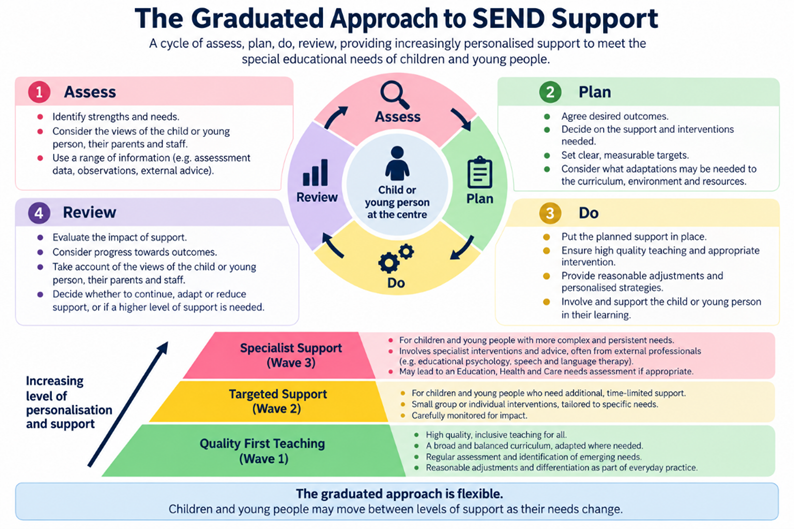
The Graduated Approach to SEN Support
In accordance with the SEND Code of Practice (2015), the school adopts a graduated approach to meeting pupils' special educational needs.
This is a continuous four-part cycle of Assess, Plan, Do and Review, through which provision is identified, implemented, evaluated and refined in response to each pupil's needs and progress.
The pupil and their family remain central to this process, with their views actively sought and considered at every stage. The graduated approach ensures that support is personalised, outcomes-focused and responsive to changing needs.
The following diagram illustrates the school's graduated approach and how support may be adapted or intensified according to individual needs.
Requesting an Education, Health and Care Needs Assessment
Some pupils with complex or long-term needs may require a level of special educational provision that cannot reasonably be provided through SEN Support alone. Where appropriate, the school will work in partnership with parents and carers and relevant professionals to consider requesting an Education, Health and Care (EHC) needs assessment from the London Borough of Hounslow.
The Local Authority is responsible for deciding whether an EHC needs assessment is necessary and, following an assessment, whether an Education, Health and Care Plan (EHCP) should be issued. An EHCP sets out the pupil's identified special educational needs, the special educational provision required to meet those needs and the outcomes to be achieved. It also includes relevant health and social care needs and provision.
Parents and carers also have the right to request an EHC needs assessment directly from the Local Authority.